Tuesday, May 31, 2011

Great Moments In Inviting Consumers To Delude Themselves III

Politicians in a democracy have a marketing problem.

They - the good ones, in any case - tend to genuinely want to participate in policy-making for the benefit of their nation.  The problem is that their consumers, the voters, have little understanding of policy issues.  This can be because the subject matter is arcane or because the correct answer simply cannot be known.     

Consider, for example, the insane economics of taxation.  Multiple textbooks have been written on the subject by all manner of very educated people.  But the voter has no time for textbooks worth of economic theories.  Add to that the fact that many taxes aren't designed to raise revenues for the government, so much as they are to reprice certain activities and, in doing so, influence behavior.

As an example, the US government wants to encourage people to invest their money.  So, they create a capital gains tax (which is actually a tax break).  People who keep their money in the market for a long enough time pay a lower percentage of the amount earned than from their other income. 

This was all pretty straightforward until the market for consumer goods started to dry up in 2008.  Then the government tried to use tax policy to encourage spending by sending everybody six hundred dollars.  We had a situation where US tax policy was simultaneously encouraging saving AND spending.  (Incidentally, most people used the rebates to pay off consumer debt, making the whole thing a complete waste of time.)

The upshot is that the voting public doesn't understood any of this.  I don't understand it.  Many economists can't even agree whether they understand it.  And nobody - politician, economist or voter - could reliably predict what the competing tax policies would do to the economy.

So, the politician who wants to talk about this stuff is pretty much out of luck.  Most people aren't going to understand him.  But they like this ...

... even though it makes no sense, because any change in the way the US collects money at all is, technically, a tax of some sort.  If the population increases by four people and you tax them, those are new taxes.  If the population increases by four people and you don't tax them, that increases the relative burden on everybody else and those are still new taxes.

So politicians become products - branded and marketed to consumers like cars, or hotel chains or really patriotic ice cream.  And George H.W. Bush says something that he doesn't even believe (he said as much when he ran against Reagan) to get elected President.

The politician himself is the brand and everything that comes from that politician has to reinforce that image.  It's not a new concept.  Joe McGinniss popularized it in 1968's The Selling of the President.  The one who wins is the one that creates "a concise brand that everyone understands and relates to without much effort."  The candidate has to sell trust, because he can't sell the issues.  That's why voters hate adultery.  They substitute it for any real examination of the candidate's character as a leader, because no one knows how he'll perform as a leader (let alone what long-term effect any of his policies would have).

Our winning Presidents have all invented themselves as brands:

From L to R:  No New Taxes, Yes We Can, I'm Just Like You,
Check Me Out, and Look How Much I'm Not Richard Nixon
And that's what our losers have tended to fail at.  The politician who does not define herself runs the risk of having the opposition do it for her.

Take Sarah Palin.  Please. 

Palin had actually built a fairly stable brand image of herself in Alaska.  She played her cards close to the vest (literally, she never even bothered to inform her staff she was pregnant), took no nonsense, and did whatever the hell she wanted.  That's exactly the brand of person Alaskans love.  In 2007, she had a 93% approval rating.

Then she hit the national stage ... where nobody had ever heard of her.  For arguable reasons, Palin stayed undefined in the voters' minds.  For two whole weeks.  That's how long it took Seth Meyers to write a cold open for Saturday Night Live that presented a concise message about Sarah Palin that everyone could understand without much effort:  Sarah Palin lacks even basic self-awareness.  It changed the debate, it robbed McCain of gravitas, and it may have swayed an election.

The smartest political operatives of 2008, God help us all.
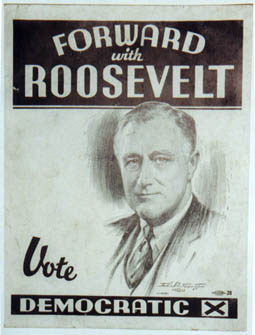
But the third Great Moment In Inviting Consumers To Delude Themselves does not belong to Palin or Obama or Seth Meyers.  It belongs to a man who ran for President long before anyone would ever admit that a candidate was being "marketed" at all.  It belongs to this guy:

Pictured: Franklin Delano Roosevelt
Not Pictured:  Wheelchair
There he is, FDR, standing proudly and waiving to the voters.  You can get plenty of pictures of him standing. Here he is being propped up by his wife.  Here he is leaning against a building.  This is him being held up by the Secret Service.

He was always supported by something.  And there was a reason:  Franklin Roosevelt could not walk.  He couldn't even stand.

GBS is also called Landry's Paralysis after
Joan Allen's character in The Bourne Identity 
In 1921, at the age of 39, he was struck with a painful paralysis that moved up his legs, gradually affecting his arms and face.  It gradually resolved, but left both legs paralyzed and his leg muscles severely atrophied.  It was thought at the time to be polio, but was much more likely Guillain-BarrĂ© (learn more about it here).

Roosevelt developed strategies for appearing more able-bodied than he really was.  He wore iron leg braces, held a cane with one hand and leaned all of his weight on someone, usually one of his sons, with the other.  By swiveling his hips, he could make it look like a walk.  Only four seconds of footage of him walking survive today.

FDR almost never allowed himself to be seen in public in a wheelchair.  His braces were painted black and he wore long pants to hide them.  His public appearances were carefully choreographed by the Secret Service to hide how he arrived at and left events.  The press, as was the custom at the time, never mentioned his paralysis and photographers avoided taking pictures of him in his wheelchair.  In fact, only two such pictures are known to exist.

Even with the Secret Service running interference, Roosevelt's paralysis wasn't exactly a well-kept secret.  Dozens of doctors, nurses, physical therapists, and hydrotherapy employees knew.  The entire White House press corps knew.  His whole staff, a bunch of politicians he left in New York, and his political opponents (many of whom hated him) knew.  Pretty much anyone who stood or sat next to him from 1921 on knew, as well.

In fact, everybody knew.  In a 1934 story, Time Magazine accidentally blew his cover.  Some of his detractors mentioned it.  The fabulously-named William Gibbs McAdoo, Jr. may have publicly complained about FDR's ability to win an election as a cripple.    And, as this thread reveals, most all Americans knew Roosevelt was impaired, they just didn't know the extent.
"Hey, I can walk! Vote for me!"
Still, the man helped found the March of Dimes to combat infantile paralysis.  Anybody who wanted to know, could have.  Instead, everybody in America - even people who despised him - ignored it.  Even reporters who could have made money on such a story ignored it.  Roosevelt won four terms in office and became the longest-serving President in US history.

And it is this that certifies this as a great moment in inviting consumers to delude themselves.  Roosevelt not only got an entire nation to believe he could walk, he got them to believe that it somehow qualified him to run the whole country.  He didn't lie exactly.  He just created an atmosphere that allowed people to lie to themselves.

He was a marketing genius.

He even made smoking look cool.

Monday, May 30, 2011

Finding Grass

Previously on Finding Sam Breakstone:

The sun produces energy in the form of sunlight.  People need energy.  People can't use sunlight.  The sun is absolutely useless to the human race.

Luckily, there are some species that are a little more efficient than we are.

Almost all plants are capable of photosynthesis.  The word itself means "making stuff from light."  In scientific terms, the chemical reaction is described as:

6CO2 + 6H2O + Sunlight ® C6H12O6 + 6O2


Plants absorb carbon dioxide from the air, mix it with water from the ground, expose the whole thing to sunlight and make sugar, which they keep, and oxygen, which they excrete.

How cool is that?  Have you enjoyed breathing today?  That's plant poop you're breathing.  Is that a particularly sweet apple you're eating?  A plant made it out of sunlight and air.

How much mass do plants create from thin air:  100,000,000,000,000 kilograms a year or 220 trillion pounds.  And that's just counting the weight of the carbon, it doesn't even factor in all the water.   In comparison, all of the people on earth total weigh 1 trillion pounds.

Plants eat sunlight using chlorophyll, which is green.  Every green leaf is a solar cell.  Incidentally, purple absorbs light even better than green.  Some scientists think the world was once purple .  

"I made this out of sunlight.  Enjoy your brunch!"

Which brings us, naturally, to grass.  No, the other kind.

Green grass - and there are thousands of species - is found just about everywhere.  If there is land, there is most likely grass.  In many habitats, it is the dominant vegetation.  And there's good reason.  Each blade of grass is its own plant - a single solar cell.  Nothing is wasted on making bark or fruit or flowers.  It's just a tiny panel turning sunlight into food.

There's just one problem.  Green grass, of which there is a lot, is entirely inedible by humans.  We cannot break down the cell walls.  All of the nutrition in grass is completely unavailable to us.

To review:  The sun is the source of all the energy in the world,.  We can't eat sunlight.  Green grass is relatively efficient at turning solar energy into food energy.  We can't eat grass, either.

If only there were some way to convert green grass into something we can eat.

And if only it had something to do with the dairy industry ...

Next:  What this all has to do with the dairy industry.

Nice grass.  I'll take an eighth.
     

Friday, May 27, 2011

Finding Sol

Consider the sun.

Now consider me.  Now back to the sun, now back to me.

"I am the sun your sun could smell like."
The sun is basically a huge nuclear explosion.  Very nearly all of the energy on earth comes from the sun.  And it's a lot of energy.  The sun produces 3.8 x 1026 Joules per second of energy.  Of that, the Earth gets 1.8 x 10¹⁷ Joules every second.  Is that a lot?  Think of it this way:  The sun is transforming 8,000,000,000 pounds of material into energy every second.  Of those eight billion pounds, Earth is getting four and a half - not four and a half billion.  Four and a half pounds total..

Chili's: a day's worth of calories
in hamburger form.
Does that not seem like much?  Consider this:  the total energy consumption of the entire human race - homes, cars, factories, farms, everything - is about 1/10,000 of that.

Does any of this relate to milk, or Breakstone's sour cream in any way?  We can only hope.

The average adult needs about 2,000 calories a day.  That's 8,368 Kilojoules every day.  The earth is getting 180 trillion Kilojoules from the sun every second.  If we could convert sunlight directly into food energy, we could feed 21.5 billion people a second.  We could, using the sun's energy, feed every single person on planet earth for the entire day in a little less than a third of a second.

2.7 hours of this and nobody on earth
 will have to eat for eighty years.
Unfortunately, people can't eat sunlight.  In fact, except for production of Vitamin D, sunlight is completely useless as a source of energy for the human body.  You could live just as well in a cave or, say, Scotland.

Our inability to eat the sun, though poetic, is hardly universal.  What we need is a way to turn solar energy into available calories.  Tomorrow:  Grass.

Monday, May 23, 2011

Finding Skinny Bitches

Jane Austin drank milk and she turned out okay.
I hear she looked a lot like Anne Hathaway.
It is a truth universally acknowledged, that a computer in possession of a good internet connection must be in want of a crazy person.  Hence, you get dark corners of the web where this is considered normal.

One of the strangest areas of disagreement on the net involves dairy.  There are those who absolutely love milk and those who absolutely hate it.  Depending on what you read, milk either strengthens the immune system or "damages the human immune system."

The one fact that all anti-milk campaigns keep coming back to was well-stated in the popular amateur diet book, Skinny Bitch:
We are the only species on the planet that drinks milk as adults. We are also the only species on the planet that drinks the milk of another species.
They're not entirely right.  There are certain birds and feral animals that have been documented as stealing milk from nursing mothers.  But they are mostly right, humans are the only mammals on earth who habitually drink milk into adulthood, and who drink the milk of other animals.

And if you don't really think about it, that sounds like a very bad thing.  If we are the one exception, chances are we're doing something wrong.  You never hear about lions being in and out of the hospital with intestinal bleeding, or southern wright whales complaining of arthritis and swollen joints.
Ow, my back!
But a couple of moments of reflection reveal some serious logical flaws in this argument:

  1. We are the only mammals who consume the milk of other mammals, and into adulthood no less,
  2. Thus, we are wrong.    
Note the logical fallacies of:  Appeal to Common Practice; Appeal to Popularity; Begging the Question (in a suppressed premise); Misleading Vividness; and a delightfully tart Red Herring.

They all add up to the same thing:  The fact that only one group does something is not evidence that it is right or wrong.  It is not evidence of anything.
Oh, everybody's getting married today?
Well, I hadn't planned on it, but ...
The question is whether milk is healthy for human adults.  The answer cannot lie in how other species feel about milk, or in how alone we are in using dairy.  It can only be found by examining what milk does for the human body.

There are, of course, plenty of things that would fit in the "Skinny Bitch" quote that show how illogical their argument is:
  1. We are the only species on the planet that has ever gone to the moon on purpose.
  2. We are the only species on the planet that tries to predict the weather a week in advance.
  3. We are the only species on the planet that can write diet books without first receiving a formal education in nutrition.  
Would the authors of "Skinny Bitch" say that we shouldn't be going to the moon, predicting weather, or writing diet books without an adequate grounding in human physiology?

The truth is that there is a good evolutionary reason why cow's milk is a growing part of the human diet - and why fermented milk products like sour cream and cheese are even more important.

Subscribe to the blog to learn how milk saved the world.

Finding The Last Sam Breakstone, The Real One

In these two posts, I combed the historical data to find five men and one girl who's still in law school who are not Sam Breakstone.  Only three remain:

Sam Breakstone #7 doesn't have much going for him.  We have no records of his parents at all.  He was born about 1885 somewhere, as we all were.  His death is not recorded.  He married a woman who may have been named Rebecca in 1907. They had one son, Stanley, born May 10, 1908 in Chicago.  Stanley did not go on to marry or have children.  He died as a baby on June 27, 1909.  And that's all we know about this Sam Breakstone.  Let's hope his small family is resting in peace.

Senator Joe McCarthy was also born in 1908.
Why is it that all the wrong people die in infancy?
That's where he was born.
Are those signs in Yiddish?
Sam Breakstone #8 is born in 1898 in Manhattan.  He was married in 1918 in New York and died in 1981 in Vermont.  He had two girls in the 1920's.  Both of them got married but there are no records of any children or their deaths.

Sam's relations are interesting.  He was the son of a Morris Breakstone, born in 1870.  Morris Breakstone features heavily in the beginnings of Breakstone Brothers, but this seems to be a different person. His genealogy cannot be made to connect to Joseph and Isaac Breakstone.  This Sam just floats alone through time.  Perhaps he was a distant relative who got some work from Breakstone Brothers based on his name.  He couldn't have been that important to the organization because so little is known of him.

I am beginning to suspect that Sam may be too common a name for my tastes.

Sam Breakstone #9 is our very last suspect.  Right out of the gate, he's got a lot to recommend him.

First of all, he was born in New York in 1884, making him old enough to have participated in the early workings of the Breakstone's dairy distributorships in the late 1890's and been a meaningful contributor in the first two decades of the 1900's.

Second, he is the son of Judah (Julius) Breakstone.  Julius was born in Lithuania, like all close Breakstone relatives.  In fact, he was Joe and Isaac's cousin.  Sam was the 1st cousins once removed of Joe and Isaac Breakstone.

We know that, in 1904, a Samuel Breakstone and Abraham Levine began a small dairy company.  About that Sam, we know he had a sister, Sarah.  Sam #9 has a sister Sarah, and he would have been a good working age, 20, when such a concern was started.

Was this Sam Breakstone in competition with his cousins?  Was he running a satellite store, as several Breakstones did?  Was it eventually folding in to the entire Breakstone's operation?  Or was his a separate business that opened and eventually closed on its own?

These questions are, for now unanswered.   No one has yet been able to tell how Breakstone and Levine fit into the story of Breakstone Brothers.

Still, he's our best Breakstone yet.  But which one of these fine eight men and one woman was the inspiration for that character of Sam Breakstone as marketed by Kraft Foods?

The answer after this ...

Jon Lovitz as Michael Vale on season 23 of Saturday Night Live.


And now the moment of revelation.  According to unofficial Breakstone's historian Jeff Marx, the real Sam Breakstone was ...

None of them.

According to Rabbi Marx's research, Sam Breakstone was entirely made up by Kraft and their marketing agency.  He represented no person or amalgam of people who ever lived.  No stories survive in the family of any man similar to him.  No stories survive of any Breakstone being obsessed with his product to such a degree.  Instead, the Breakstones were pragmatists who worked to control as much of the production of dairy items as possible, and to distribute products as efficiently as possible, in order to make the most money.  Sam Breakstone tinkering in his kitchen is completely fictitious.

In contrast, Queen Amidala is 78% real.
Knowing that there was no Sam Breakstone is hardly the end of this inquiry.  It's important to learn how Kraft created the Breakstone character, why they felt so confident inventing history, and how they managed to be so successful.  Knowing Sam Breakstone didn't exist is the first step  Knowing how a fictional spokesperson is born is the next.  Knowing what informs the choices we make about what we eat is the goal.


Saturday, May 21, 2011

Finding Time

This has been a busy weekend, if you figure in my naps.

In two previous installments, we examined some of the possible candidates who could have been the real Sam Breakstone.  You can read Part One here, and Part Two here.   Tomorrow night, we'll examine the last two individuals who might be the real Sam Breakstone and we'll hear the final pronouncement of the unofficial genealogist of the Breakstone family as to which of our eight contestants it really is.

Until tomorrow night, why not go back and read about how this all began those many long three weeks ago.

Or, you could enjoy a television commercial for a food product where the brand message was a little off, in that the mad men who wrote this commercial seem never to have met an actual, fully functioning, human female before.

Three speeds.  Can be bolted to a horse saddle.
In the 1960's, Post sold a cereal called Size 8.  This ad, written by D'Arcy Masius Benton & Bowles, appears to make the following assumptions about their target audience:

  1. Women around a size 8, really, really want to stay that size.
  2. Bigger women should just go find another cereal.
  3. Real women with, like, kids and jobs and things suck and shouldn't use our product
  4. Women do not care how cereal tastes
  5. Women do not care how anything tastes so long as it guarantees some level of weight loss.
  6. Men should stay away from this cereal, as should all children not on hormone replacement therapy
  7. Nothing about this product matters, women will buy it because of the pretty packaging.
  8. There is a sexual innuendo in this ad about how much women like Size 8, I just don't know what it is.

Enjoy the commercial and learn how not to create a brand identity.

Friday, May 20, 2011

Finding A Good Production Still - Do Over

Among the documents that Nancy Vale sent, is this great still photo of Michael Vale as Sam Breakstone.

The picture is undated, but judging by the materials it was sent with, is probably circa 1985.


The original is in color.  That's coming as soon as I figure out how to do that.  I assume I need some sort of equipment.

Note the anachronisms that mark this as marketing for a product.  The microphone is most likely a Calrad 500C, circa the 1950's.  They're supposedly terrible for sound.  They "pill" style followed the success of the RCA 77, which could never be confused with the Calrad 500.  As one website puts it, "These are great for photos, display, prop or loading in a modern element and using on-stage."  In fact, at least one website has devoted a page to finding Calrad 500C's on TV and in print.

Kim Basinger is pretending to sing in front of one in this poster from The Marrying Man.  There's a year in their life I bet they wish they could take back.

So, Breakstone is behind a microphone invented roughly seventy years after he is supposed to have started in the dairy industry in 1882; years after both Joseph and Isaac Breakstone had passed away.

Also note that Breakstone is holding a plastic container of cottage cheese.

This type of polyethylene container did not come into use until the 1970's.  It was the modern product at the time the photo was taken.

Breakstone's hat is a men's straw boater.  They were worn (unironically) from the 1890's to the 1920's.

That's some bad hat, Harry.

One more thing bothers me about the picture:  the head of lettuce.  They are implying a connection between freshness of the produce and a milk product that is, by its very nature, partially spoiled.  They are also implying that Sam Breakstone sold vegetables.  There is little truth to the associations that the marketers are asking us to make.

In all, Sam Breakstone stands before us, representing the goodness of the past, as he passes on the Breakstone's products to a new generation.

Even so, one thing remains clear, this is the highest resolution image of Kraft Foods's Sam Breakstone currently available on the internet.  And that makes me a real journalist.

Follow, link, share and stay tuned.